

Board Performance · 2025
In this section14 topics
- Prevention of Conflicts of Interest3 items
- Prevention of the Use of Inside Information3 items
- Anti-Corruption4 items
- Whistleblowing3 items
- Selection of Directors & Chief Executives8 items
- Selection of Independent Directors2 items
- Director Development2 items
- Evaluation of Board & Subcommittee Performance3 items
- Subcommittees1 item
- Meeting Attendance & Remuneration5 items
- Supervision of Subsidiaries & Associated Companies4 items
- Board Duty Performance — Overview1 item
- Audit Committee Duty Performance1 item
- Executive Committee Duty Performance1 item
Prevention of Conflicts of Interest
Has the Company Acted to Prevent Conflicts of Interest?
Yes
Operations in the Past Year
Directors and Executives
The Company requires directors and executives to fully, accurately, and timely report any transactions that may give rise to conflicts of interest, in compliance with the Public Limited Companies Act B.E. 2535 (1992), the Securities and Exchange Act B.E. 2535 (1992) (as amended), as well as the regulations of the Securities and Exchange Commission (SEC) and the Stock Exchange of Thailand (SET). Directors and executives must disclose any personal interests or those of related persons and must abstain from participating in the consideration or voting on such matters to ensure transparency and fairness in the Company’s operations.
Employees
The Company requires employees at all levels to disclose and report any potential conflicts of interest to their supervisors or relevant departments, in accordance with good corporate governance principles and the Company’s Code of Conduct, as well as applicable laws and regulations. This is to prevent any personal gain that may adversely affect the Company’s interests.
The Company has established a Code of Conduct, which is reviewed annually by the Board of Directors as a guideline for business operations. All employees are required to undergo training on the Code of Conduct. In addition, the Board of Directors, senior executives, and employees in accounting, sales, marketing, and procurement functions are required to sign a conflict of interest disclosure form to affirm compliance with the policy and to enhance transparency in the Company’s business operations.
Number of Conflict-of-Interest Cases
| Metric | Current Year | Previous Year | Two Years Ago | Remark |
|---|---|---|---|---|
| Total number of cases or issues related to conflicts of interest (cases) | 0 | 0 | 0 | From 2023-2025, "No" cases or issues related to conflicts of interest were found. |
Prevention of the Use of Inside Information
Has the Company Acted to Prevent the Use of Inside Information?
Yes
Operations in the Past Year
Planet Communications Asia Public Company Limited places great importance on preventing the misuse of inside information for personal gain. The Company has established clear policies and guidelines in its Code of Conduct to ensure fairness and equal treatment for all shareholders, in line with the principles of good corporate governance for companies listed on the Market for Alternative Investment (mai).
The Company defines inside information that has not yet been disclosed to the public and may affect the Company’s securities prices as confidential information that must be protected. Directors, executives, employees at all levels, and related persons are strictly prohibited from disclosing such information or using it, directly or indirectly, for personal gain in trading the Company’s securities.
The Company has implemented key measures, including:
Prohibiting the use or disclosure of inside information for personal or others’ benefit
Prohibiting trading of the Company’s securities based on inside information prior to public disclosure
Establishing a blackout period prior to the disclosure of financial statements
Requiring directors and executives to report their securities holdings and any changes thereto, including those of their spouses and minor children
These measures are in compliance with the Securities and Exchange Act B.E. 2535 (1992), particularly Section 59 regarding the reporting of securities holdings and provisions relating to insider trading. Any violation is subject to legal penalties as well as the Company’s disciplinary actions, to maintain transparency and investor confidence on a sustainable basis.
The Company also requires management to report changes in securities holdings of directors and executives to the Board of Directors on a quarterly basis, ensuring transparency and appropriate oversight.
In 2025, directors and senior executives fully complied with the reporting requirements by submitting disclosures of changes in securities holdings through the Stock Exchange of Thailand’s system. The Company summarized and reported such information to the Board of Directors on a quarterly basis. No trading of the Company’s securities by directors or executives was found during the blackout period.
Number of Inside-Information Cases
| Metric | Current Year | Previous Year | Two Years Ago | Remark |
|---|---|---|---|---|
| Total number of cases or issues related to the use of inside information to seek benefits (cases) | 0 | 0 | 0 | Year 2023-2025 "No" cases or issues related to the use of inside information for personal gain were found. |
Anti-Corruption
Has the Company Acted on Anti-Corruption?
Yes
Operations in the Past Year
The Board of Directors has established an anti-corruption policy to prevent and mitigate risks of fraud across all organizational activities. The policy emphasizes conducting business with transparency and in alignment with good corporate governance principles. The Risk Management Committee has been assigned to oversee, monitor, and continuously assess the effectiveness of the measures.
The Company promotes awareness and understanding of anti-corruption practices among employees at all levels by incorporating such topics into orientation programs and requiring strict adherence to the Company’s Code of Conduct.
This policy is reviewed annually by the Board of Directors. In 2025, 100% of employees acknowledged the policy, and no incidents of corruption were identified within the organization. This reflects the effectiveness of the Company’s governance framework and its strong commitment to fostering a culture of integrity.
Declaration of Intent to Join the Thai Private Sector Collective Action Against Corruption (CAC)
The Company declared its intention to participate in the Thai Private Sector Collective Action Against Corruption (CAC) in 2018. It has implemented policies on risk assessment, guidelines, monitoring systems, and reporting processes in alignment with the CAC requirements.
The Company was first certified as a CAC member on May 17, 2018, and has successfully renewed its certification continuously—first renewal on March 31, 2022, and second renewal on March 31, 2025. The latest certification is valid until March 31, 2028, reflecting the Company’s ongoing commitment to conducting business with transparency and free from corruption.
Form of Anti-Corruption Operations
| Operation |
|---|
| Review of appropriateness in anti-corruption |
| The participation in anti-corruption projects |
| Communication and training for employees on anti-corruption policy and guidelines |
| The monitoring of the evaluation of compliance with the anti- corruption policy |
Number of Corruption Cases
| Metric | Current Year | Previous Year | Two Years Ago | Remark |
|---|---|---|---|---|
| Total number of cases or issues related to corruption (cases) | 0 | 0 | 0 | From 2023 to 2025, "No" cases or issues related to corruption were found. |
Whistleblowing
Has the Company Implemented Whistleblowing Procedures?
Yes
Operations in the Past Year
The Company encourages employees, shareholders, and all stakeholders to participate in good corporate governance by providing opportunities to raise inquiries or report misconduct, violations of laws, company regulations, or the Code of Conduct, as well as any incidents that may cause damage to the Company.
The Company has established multiple accessible whistleblowing channels. Reports can be submitted through supervisors, the Chairman of the Audit Committee, the Chairman of the Board, the Company Secretary, via the Company’s website, or by post addressed to:
Chairman of the Board or Chairman of the Audit Committee
Planet Communications Asia Public Company Limited
157 Soi Ram Inthra 34, Tha Raeng, Bang Khen, Bangkok 10230
The Company has implemented whistleblower protection measures to ensure confidentiality and to protect whistleblowers from retaliation or any adverse consequences. This aims to build confidence in reporting concerns in good faith and fairness.
Details are outlined in the Company’s Whistleblowing Policy, which has been communicated to all employees and stakeholders and is reviewed annually to ensure its appropriateness and alignment with current circumstances.
The Company is committed to fostering a transparent, accountable, and sustainable corporate culture grounded in good governance principles.
Number of Whistleblowing Cases
| Metric | Current Year | Previous Year | Two Years Ago | Remark |
|---|---|---|---|---|
| Total number of cases or issues received through whistleblowing channels (cases) | 0 | 0 | 0 | From 2023-2025, "No" cases or issues were found to be received through the whistleblowing channel. |
Selection of Directors & Chief Executives
Selection, Development & Evaluation — Introduction
The Board of Directors’ Meeting No. 5/2014, held on November 12, 2014, resolved to approve the appointment of the Nomination, Remuneration and Corporate Governance Committee (the “NRC Committee”). The NRC Committee is required to hold meetings at least twice a year, and members must attend the meetings in person. During 2023–2025, the Company held NRC Committee meetings 3 times, 2 times, and 4 times respectively. The average attendance rate of the NRC Committee members was 100%.
Selection — Introduction
In 2025, the Nomination and Remuneration Committee conducted the nomination process to appoint qualified individuals to serve as directors of the Company, totaling three persons, as follows:
Ms. Chutsuda Benjanirat was appointed as a new director, as approved by the Annual General Meeting of Shareholders for the year 2025 held on 25 April 2025.
Lt. Somsak Yamasamit was appointed as a director in replacement of Dr. Wichai Laohmatvanich, who expressed his intention not to continue for another term, as approved by the Annual General Meeting of Shareholders for the year 2025 held on 25 April 2025.
Mr. Sorasak Chuntaravanick was appointed as a director in replacement of Dr. Ruttikorn Varakulsiripunth, who resigned from the position of director, as approved by the Board of Directors’ Meeting No. 4/2025 held on 6 May 2025.
The Nomination and Remuneration Committee considered that all three directors possess the knowledge, capabilities, and experience in various fields beneficial to the Company’s operations. They are also persons of integrity and ethics, possessing all qualifications required under the Public Limited Companies Act B.E. 2535 (1992) and the notifications of the Securities and Exchange Commission, and do not have any prohibited characteristics under the Securities and Exchange Act B.E. 2535 (1992). They are able to express their opinions independently and in accordance with the relevant regulations.
Directors & Chief Executives — Introduction
The Nomination and Remuneration Committee is responsible for selecting qualified and suitable individuals for appointment as directors of the Company and proposing such nominations to the shareholders’ meeting for consideration, as well as for senior executive positions. In this process, the Committee may consider candidates from the Thai Institute of Directors (IOD) database.
Are Directors Selected Through the Nomination Committee?
Yes
Are Chief Executives Selected Through the Nomination Committee?
Yes
Number of Directors from Major Shareholders
1
Rights of Minority Shareholders on Director Appointment
The Company places importance on protecting the rights of all shareholders equally, including minority shareholders. It provides opportunities for qualified shareholders to participate in nominating suitable candidates for directorships in advance of the Annual General Meeting of Shareholders (AGM).
In 2025, the Company announced through the Stock Exchange of Thailand’s system to invite shareholders to propose agenda items and nominate qualified individuals for directorship. Shareholders were allowed to submit proposals in advance in accordance with the criteria disclosed on the Company’s website during the period from 1 November 2024 to 30 January 2025. In the event that the Board of Directors does not include any proposed items in the agenda, the Company will provide reasons to the shareholders’ meeting.
For the nomination of candidates for directorship, shareholders must hold shares in the proportion specified by the Company and submit supporting information such as background, qualifications, and experience. The Nomination and Remuneration Committee will consider the suitability of candidates based on their knowledge, capabilities, experience, independence, and alignment with the Board structure, before proposing to the Board of Directors and subsequently to the shareholders’ meeting for appointment.
This practice aims to promote the participation of minority shareholders, enhance transparency in the director nomination process, and support the Company’s good corporate governance
Method of Director Appointment
| Method |
|---|
| Method whereby each director requires approval votes more than half of the votes of attending shareholders with voting rights |
Selection of Independent Directors
Criteria for Selecting Independent Directors
Planet Communications Asia Public Company Limited has defined the qualifications of its directors in accordance with the criteria for “Independent Directors” as prescribed by the Securities and Exchange Commission of Thailand (SEC). An “Independent Director” of the Company refers to a director who possesses the following qualifications:
Holds no more than 1% of the total voting shares of the Company*, including shares held by related persons of such independent director
Is not, and has not been, a director involved in management, an employee, staff member, advisor receiving a regular salary, or a controlling person of the Company*, unless at least two years have passed since ceasing such position
Is not a person related by blood or legal registration to other directors, executives, major shareholders, controlling persons, or persons nominated to be executives or controlling persons of the Company or its subsidiaries
Has no, and has not had, any business relationship with the Company* that may impair independent judgment, and is not, and has not been, a significant shareholder or controlling person of an entity having a business relationship with the Company*, unless at least two years have passed since ceasing such relationship
Is not, and has not been, an auditor of the Company*, and is not a significant shareholder, controlling person, or partner of an audit firm whose auditor serves the Company*, unless at least two years have passed since ceasing such relationship
Is not, and has not been, a provider of professional services, including legal or financial advisory services, receiving fees exceeding THB 2 million per year from the Company*, and is not a significant shareholder, controlling person, or partner of such service provider, unless at least two years have passed since ceasing such relationship
Is not a director appointed as a representative of the Company’s directors, major shareholders, or shareholders related to major shareholders
Does not operate a business of the same nature and in significant competition with the Company or its subsidiaries, and is not a significant partner, director involved in management, employee, salaried advisor, or shareholder holding more than 1% of voting shares in another company engaged in such competing business
Does not have any other characteristics that may prevent the ability to express independent opinions regarding the Company’s operations
Did Any Independent Director Have a Business or Professional Relationship?
No
Director Development
Director Development — Introduction
The Board of Directors has a policy to promote and support directors and executives in continuously enhancing their knowledge through training programs, both internally and externally, to improve performance and strengthen their understanding of roles and responsibilities. The Company encourages participation in training programs organized by relevant institutions, such as the Thai Institute of Directors (IOD) and the Securities and Exchange Commission (SEC), to align with good corporate governance principles and applicable standards.
As of December 31, 2025, the Company had directors who completed director-related training programs, including nine directors who completed the Director Accreditation Program (DAP) and five directors who completed the Director Certification Program (DCP), organized by the Thai Institute of Directors (IOD). Mr. Prapat Rathlertkarn and Mr. Trevor John Thompson completed both programs. In total, all 11 directors (100%) have participated in relevant training programs, reflecting the Company’s commitment to enhancing knowledge and strengthening corporate governance capabilities.
The Company places importance on regularly conducting orientation programs for new directors to ensure they are well informed about key aspects of the Company’s operations, business nature, and corporate governance practices, enabling them to perform their duties effectively.
Such orientation programs are conducted by the Company Secretary and senior executives from relevant functions, covering key topics such as mission and vision, shareholding structure, business overview, products and services, Board and subcommittee structures, meeting schedules, director remuneration policies, guidelines on reporting and securities trading, including blackout periods (silence periods), as well as information on training programs provided by the Thai Institute of Directors (IOD).
In 2025, the Company conducted orientation programs for three newly appointed directors: Acting Sub Lt. Somsak Yamasamit, Ms. Chatsuda Benjanirat, and Mr. Sorasak Chuntaravanick, to ensure effective performance of their duties in alignment with the Company’s corporate governance principles.
In addition, the Company has established a Board development plan as a guideline to enhance directors’ knowledge and capabilities, promote a comprehensive understanding of the Company’s business, and enable each director to apply their knowledge and experience effectively in fulfilling their roles and responsibilities within the Board. The key elements of the plan are as follows:
Newly Appointed Directors
Newly appointed directors will be provided with comprehensive information to ensure a clear understanding of the Company’s business operations, including details of duties and responsibilities as specified in the Board Charter. They will also be introduced to the Company’s objectives, goals, vision, mission, and core values, which serve as fundamental knowledge for participation in Board meetings. In addition, guidance will be provided regarding legal and regulatory requirements applicable to directors of listed companies on the Stock Exchange of Thailand, as well as the Company’s Articles of Association, prior to assuming their duties. This process follows the Board Orientation Guideline of the Stock Exchange of Thailand.
Continuous Development of Directors’ Knowledge
2.1 All directors will be provided with information necessary to ensure proper understanding of their responsibilities as directors of a listed company, such as reporting the holding and changes in shareholdings of the Company and compliance with related party transaction regulations.
2.2 Directors are encouraged to attend at least one fundamental director training course as recommended by the Thai Institute of Directors Association (IOD).
2.3 Directors serving on sub-committees, such as the Audit Committee, the Nomination and Remuneration Committee, the Risk Management Committee, and the Executive Committee, will be supported to attend training programs relevant to their specific roles and responsibilities.
2.4 The Company has a policy to promote continuous learning for directors through additional training programs, seminars, and discussions on topics relevant to business developments and beneficial to their duties. Training may be conducted through in-house programs or external institutions such as the Thai Institute of Directors Association (IOD), the Securities and Exchange Commission (SEC), the Stock Exchange of Thailand (SET), the Capital Market Supervisory Board, or other relevant organizations.
Review and Improvement of the Director Development Plan
The Company has assigned the Company Secretary as the primary responsible person to collaborate with the Nomination and Remuneration Committee and the Human Resources Department in regularly reviewing and improving the Director Development Plan. The updated plan will then be proposed to the Board of Directors for approval, with the objective of ensuring that the development plan remains up to date and responsive to the evolving business environment.
Qualifications for Director Selection — Introduction
Qualifications of the Board of Directors
Directors of the Company must possess the qualifications required under the Public Limited Companies Act and the Company’s Articles of Association, and must not have any prohibited characteristics or lack of trustworthiness as prescribed by the notifications of the Securities and Exchange Commission.
Public Limited Companies Act B.E. 2535 (1992), Section 68, stipulates that:
A director must be a natural person.
Must have reached the age of majority.
Must not be bankrupt, incompetent, or quasi-incompetent.
Must not have been sentenced by a final judgment to imprisonment for an offense relating to property committed dishonestly.
Must not have been dismissed or removed from government service, an organization, or a government agency on the grounds of corruption.
Securities and Exchange Act B.E. 2535 (1992), Section 89/3, stipulates that:
Directors must possess qualifications and must not have prohibited characteristics as prescribed under the law governing public limited companies.
Directors must not have characteristics indicating a lack of suitability to be entrusted with the management of a company with public shareholders, as prescribed by the Capital Market Supervisory Board.
Possess leadership, broad vision, and an understanding of the Company’s business operations.
Be able to perform their duties and express opinions independently, and dedicate sufficient time to perform their responsibilities.
Hold directorships in no more than five listed companies.
Evaluation of Board & Subcommittee Performance
Criteria for Evaluating Board Performance
In accordance with the Corporate Governance Code for Listed Companies, it is recommended that the Board of Directors and the Board Committees of listed companies conduct a self-assessment of their performance at least once a year. This evaluation enables the Board to jointly review its performance and identify areas for improvement. The evaluation should be conducted both on a collective basis (board evaluation) and an individual basis (individual director evaluation). This practice also promotes and supports listed companies in conducting regular and continuous evaluations of the Board of Directors and Board Committees each year.
Accordingly, the Company conducts an annual performance evaluation of the Board of Directors and its Board Committees, both collectively and individually, in order to enhance the effectiveness of the Company’s corporate governance. The evaluation covers the following key areas:
Board Evaluation (Collective Assessment)
Board structure and composition
Roles, duties, and responsibilities of the Board
Board meetings
Performance of directors
Relationship with management
Director development and executive development
Individual Evaluation
Board structure and director qualifications
Board meeting participation
Roles, duties, and responsibilities of the Board of Directors
The Company has established criteria for interpreting the evaluation scores based on a maximum score of 4 points, with results categorized into five levels: Excellent, Very Good, Good, Fairly Good, and Satisfactory. An average score of 3.50 – 4.00 is considered Excellent, 3.00 – 3.49 is considered Very Good, 2.50 – 2.99 is considered Good, 2.00 – 2.49 is considered Fairly Good, and a score below 2.00 is considered Satisfactory.
Evaluation of Board Performance in the Past Year
The summary of the committee evaluations for the year 2025 as follows:
Board of Directors
Committee evaluation: 3.56 points, rated as Excellent
Individual evaluation: 3.61 points, rated as Excellent
Audit Committee
Committee evaluation: 3.82 points, rated as Excellent
Individual evaluation: 3.72 points, rated as Excellent
Nomination, Remuneration, and Corporate Governance
Committee Committee evaluation: 3.96 points, rated as Excellent
Individual evaluation: 3.83 points, rated as Excellent
Risk Management Committee
Committee evaluation: 3.40 points, rated as Very Good
Individual evaluation: 3.65 points, rated as Excellent
Evaluation Results
| Evaluated Body | Group — Carried Out? | Group — Grade / Average Score | Group — Grade / Full Score | Individual (Self-Assessment) — Carried Out? | Individual (Self-Assessment) — Grade / Average Score | Individual (Self-Assessment) — Grade / Full Score | Cross (Assessing Other Directors) — Carried Out? |
|---|---|---|---|---|---|---|---|
| Board Of Director | Y | 3.56 | 4.00 | Y | 3.61 | 4.00 | N |
| Audit Committee | Y | 3.82 | 4.00 | Y | 3.72 | 4.00 | N |
| Other Subcommittee | Y | 3.96 | 4.00 | Y | 3.83 | 4.00 | N |
| Other Subcommittee | Y | 3.40 | 4.00 | Y | 3.65 | 4.00 | N |
Subcommittees
Subcommittees
| Results of the Subcommittee's Duty Performance |
|---|
The Nomination, Remuneration, and Corporate Governance Committee consists of three members, including two independent directors: Mr. Somkid Wangcherdchuwong (Chairman) and Dr. Kangwan Yodwisitsak, and one director, Mr. Sorasak Chuntaravanick was appointed as a member of the Nomination, Remuneration, and Corporate Governance Committee on May 6, 2025, to replace Dr. Wichai Laohmatvanich, who did not wish to continue for another term. The Nomination, Remuneration, and Corporate Governance Committee has performed its duties in accordance with its charter, as well as other responsibilities assigned by the Board of Directors. In 2025, the Committee held a total of four meetings and effectively carried out its duties, covering key areas as follows: Nomination and Appointment of Directors Succession Planning Board Performance Evaluation Remuneration Determination and Review Corporate Governance |
Risk Management Committee consists of three members: Mr. Sorasak Chuntaravanick (Chairman), Mr. Prapat Rathlertkarn, and Mr. Somkid Wangcherdchuwong. Mr. Sorasak Jantrawanich was appointed as a member of the Risk Management Committee on May 6, 2025 , to replace Dr. Wichai Laohmatvanich, who did not wish to continue for another term. The Risk Management Committee has performed its duties in accordance with its charter, as well as other responsibilities assigned by the Board of Directors. In 2025, the Committee held a total of three meetings and carried out risk management in an effective, systematic, and continuous manner, covering key areas as follows:
These efforts aim to ensure effective risk management, enhance the Company’s ability to adapt to changes, and support sustainable organizational growth. |
Meeting Attendance & Remuneration
Justification for Directors' Non-Attendance
The Company places great importance on regular attendance at Board of Directors meetings and adheres to the principle of transparency by appropriately disclosing reasons when directors are unable to attend.
In 2025, two directors were unable to attend certain Board meetings. Acting Sub Lt. Somsak Yamasamit was unable to attend Board Meeting No. 8/2025 on June 26, 2025, due to an important overseas engagement. Ms. Chatsuda Benjanirat was unable to attend Board Meeting No. 10/2025 on November 13, 2025, due to illness (influenza). However, such absences did not affect the quorum or the operations of the Board of Directors.
Types of Remuneration of the Board of Directors
The Nomination and Remuneration Committee is responsible for considering, determining, and proposing the remuneration of the Board of Directors and subcommittees to the Board of Directors and the Annual General Meeting of Shareholders for approval. The determination of such remuneration is carefully considered to ensure appropriateness with respect to the scope of duties and responsibilities of each director, alignment with the Company’s strategy and long-term objectives, and competitiveness compared to companies in the same industry.
Remuneration of the Board — Introduction
The Shareholders’ Meeting approved the Board of Directors’ remuneration structure for the years 2023–2025 as follows:
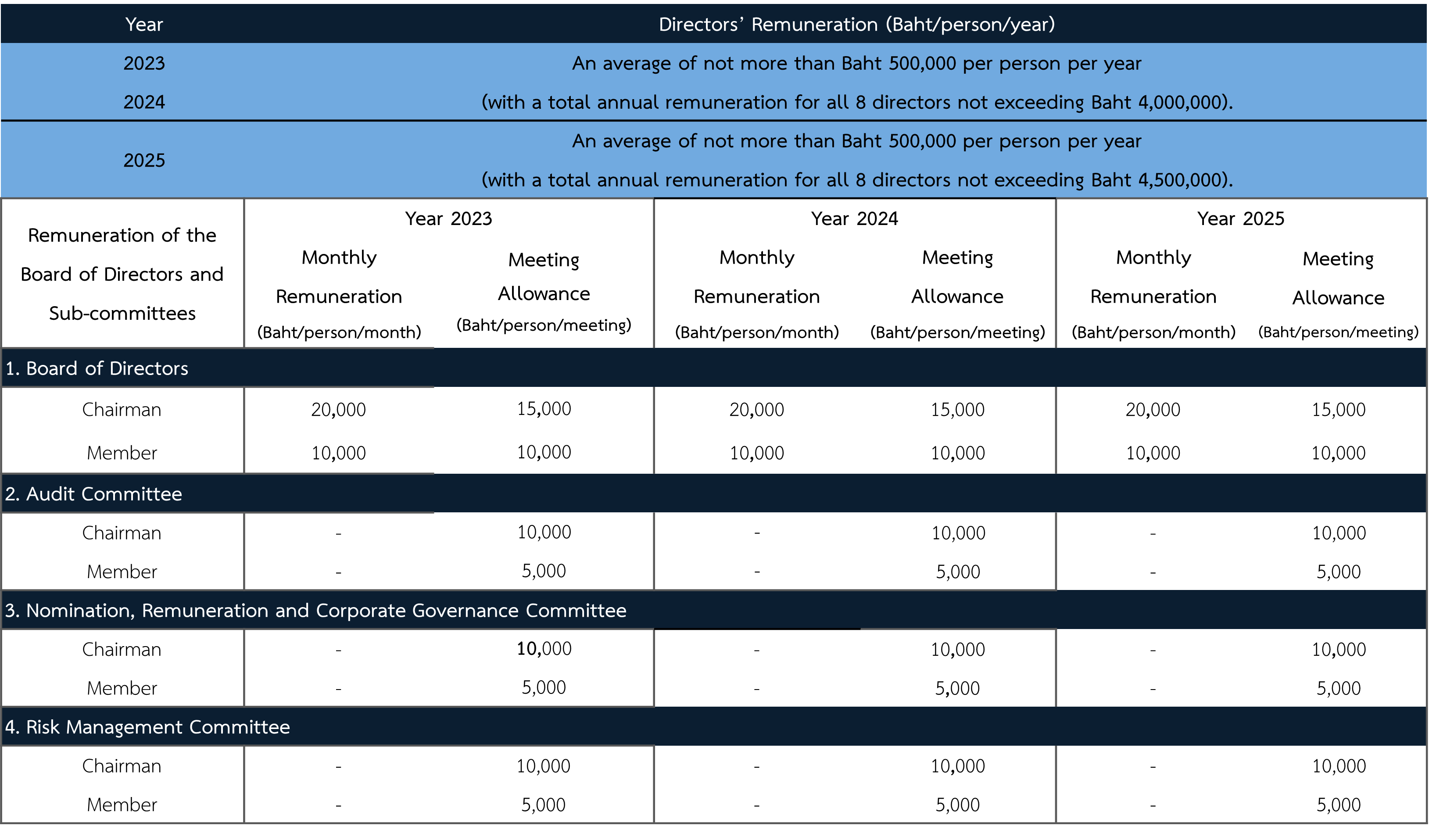
Remuneration of the Board of Directors
Remuneration or Benefits Payable to the Board
| Metric | Amount (Baht) |
|---|---|
| Remunerations or benefits pending payment to the board of directors over the past year (baht) | 0 |
Supervision of Subsidiaries & Associated Companies
Does the Company Have Subsidiaries or Associated Companies?
Yes
Is There a Mechanism for Overseeing Subsidiaries and Associated Companies?
Yes
Mechanism for Overseeing Management of Subsidiaries
The Company has established a systematic governance framework for its subsidiaries and associates by clearly defining the roles and responsibilities of directors and executives acting as representatives in setting policies and approving significant transactions. It also requires accurate and transparent reporting and disclosure of financial positions and operating results in accordance with applicable standards.
In addition, related party transactions must be conducted fairly at market prices and in compliance with regulatory requirements. Significant transactions, including acquisitions or disposals of assets, must be reviewed and approved in accordance with delegated authority levels, with full disclosure of information. This ensures that the Group’s operations are efficient, transparent, and aligned with good corporate governance principles.
Oversight Mechanisms
| Mechanism |
|---|
| Disclosure of financial information and operating results |
| Transactions between the Company and related persons |
| Defining the scope of powers, duties and responsibilities of directors and executives who represent the company in setting important policies |
| Acquisition or disposal of assets |
| Other important transactions |
Board Duty Performance — Overview
Board Duty Performance — Overall Description
The Company has established a policy requiring the Board of Directors to convene at least once every three months, with additional meetings arranged when necessary. For each meeting, the agenda is clearly specified and the meeting notice together with relevant supporting documents is delivered at least seven days in advance to allow the directors sufficient time to review the information prior to the meeting. Minutes of each meeting are recorded in writing and the approved minutes are properly maintained for inspection by the Board of Directors and relevant parties.
The Company also prepares an annual Board meeting schedule in advance and informs the Board accordingly. In 2025, the Board scheduled meetings on a quarterly basis to consider and approve the quarterly financial statements and the annual financial statements. Additional meetings were held in March and June to consider and approve other matters as appropriate.
The schedule for the 2026 Annual General Meeting was approved by the Board of Directors at its 10/2025 meeting on November 13, 2025. The company secretary has already submitted the schedule to the Board of Directors on November 13, 2025.
A quorum for a Board meeting requires the presence of at least one-half of the total number of directors. In addition, at the time when the Board passes a resolution, at least two-thirds of the total number of directors must be present.
During the years 2023–2025, the Company held 7, 7, and 10 Board of Directors meetings, respectively. In 2025, the overall attendance rate of directors at Board meetings was 97.40%.
Audit Committee Duty Performance
Results of the Audit Committee's Duty Performance in the Past Year
The Audit Committee of Planet Communications Asia Public Company Limited consists of three independent directors with knowledge, expertise, and experience in business management, finance, accounting, internal audit, and law. Dr. Kangwan Yodwisitsak serves as the Chairman of the Audit Committee (appointed on May 6, 2025), with Mr. Somkid Wangcherdchuwong and Lt. Somsak Yamasamit serving as Audit Committee members.
In 2025, there were changes in the composition of the Audit Committee. Mr. Sorasak Mr. Sorasak Chuntaravanick was appointed on May 6, 2025, replacing Mr. Wichai Laohmatvanich, who completed his term and did not wish to continue. Subsequently, Lt. Somsak Yamasamit was appointed on August 13, 2025, replacing Mr. Sorasak Chuntaravanick, who resigned to assume other responsibilities within the Company. All Audit Committee members possess qualifications in accordance with the criteria of the Securities and Exchange Commission (SEC) and the Stock Exchange of Thailand (SET).
In 2025, the Audit Committee held a total of five meetings, with all members attending each meeting, constituting a quorum every time. The Committee regularly reported its performance to the Board of Directors on a quarterly basis. During the meetings, the Audit Committee discussed key corporate governance matters with management, internal auditors, and external auditors. The key responsibilities performed are summarized as follows:
Review of Financial and Non-Financial Reporting Systems
The Audit Committee reviewed the quarterly and annual financial statements for 2025 of Planet Communications Asia Public Company Limited together with management, internal auditors, and the external auditor. The external auditor was invited to attend meetings without management present to discuss independence and audit opinions. The Committee also inquired about the accuracy and completeness of the financial statements, significant accounting adjustments, appropriateness of accounting policies, and audit scope. This ensured that disclosures were accurate, complete, and sufficient, and that the auditor remained independent. The Committee is confident that the financial statements were prepared in compliance with applicable laws and generally accepted accounting principles, and that the accounting system is reliable with adequate and timely disclosure for investors and users. The Committee also reviewed operational performance against plans, raised key issues, and provided recommendations to ensure transparency and proper execution.
Review of Risk Management Assessment System
The Audit Committee reviewed the Company’s risk management assessment in accordance with established policies and monitored progress on key risks. By evaluating risk factors and potential impacts, the Committee ensured that significant risks were systematically assessed and promoted awareness among employees, supporting value creation for the business.
Review of Corporate Governance Practices
The Committee reviewed compliance with the Company’s code of conduct and corporate governance policies, and found that directors and employees adhered strictly to the established principles. The Committee continuously promoted ethics and integrity across all levels to ensure transparency and build confidence among shareholders, investors, customers, business partners, and stakeholders.
Review of Internal Control System
The Audit Committee reviewed the adequacy and effectiveness of the internal control system in accordance with internal audit standards and guidelines set by the SEC and the Stock Exchange of Thailand. The Committee also reviewed audit results based on the approved audit plan. Management continuously implemented improvements based on audit findings and recommendations. No material weaknesses were identified, and the Committee concluded that the Company has adequate and appropriate internal control and risk management systems.
Review of Compliance with Applicable Laws
The Committee reviewed compliance with the Securities and Exchange Act, SET regulations, SEC requirements, and other laws relevant to the Company’s business, and found that the Company has complied appropriately.
Review of Related Party Transactions and Conflict of Interest
The Audit Committee reviewed such transactions and determined that they were conducted in the ordinary course of business, were reasonable, free from conflicts of interest, and complied with SEC and SET regulations.
Review of Intercompany Transactions
The Committee reviewed disclosures of related party transactions and potential conflicts of interest on a quarterly basis, ensuring they were conducted on an arm’s length basis, with transparency, and in the best interest of the Company and its shareholders.
Review of Anti-Corruption Measures
The Audit Committee reviewed internal control measures and compliance with anti-corruption policies. The Company was certified as a member of Thailand’s Private Sector Collective Action Against Corruption (CAC) on May 17, 2018, and successfully renewed its certification (second renewal) on March 31, 2025. Internal audits conducted during the year confirmed that the Company has implemented adequate and appropriate anti-corruption measures.
Consideration for Appointment of External Auditor
The Audit Committee reviewed the qualifications, expertise, and performance of AMC Co., Ltd. Based on its independence and experience in auditing the Company’s financial statements, the Committee proposed to the Board of Directors the appointment of AMC Co., Ltd. as the Company’s auditor for 2025.
The Committee also proposed the reappointment of AMC Co., Ltd. as the auditor for another year, along with the audit fees for 2026. The proposal will be submitted to the Board of Directors for consideration and subsequently to the Annual General Meeting of Shareholders for approval.
Executive Committee Duty Performance
Results of the Executive Committee's Duty Performance in the Past Year
The Company has a total of seven Executive Committee members. Mr. Prapat Rathlertkarn serves as the Chairman of the Executive Committee, and Mr. Trevor John Thompson serves as a member of the Executive Committee. The Executive Committee is responsible for determining the direction and business strategies in alignment with the objectives set by the Board of Directors, as well as ensuring efficient and agile management. Its key responsibilities include:
Defining the Company’s direction, strategies, and business plans
Overseeing operations to ensure alignment with established objectives
Managing resources efficiently
Promoting an effective risk management system
Ensuring good corporate governance
The actions of the Executive Committee must be approved by the Chairman and Vice Chairman. Resolutions of the Executive Committee are binding on the Company in accordance with the Company’s Articles of Association and the Public Limited Companies Act B.E. 2535 (1992). In this regard, the Executive Committee has the authority to submit matters in writing to the Board of Directors for ratification, endorsement, or approval on specific matters, within the scope of authority delegated and in effect at that time.