PLANET COMMUNICATIONS ASIA PUBLIC COMPANY LIMITEDSET: PLANET🇹🇭 TH

CG Policy · 2025

Corporate Governance Policy

Has a Corporate Governance Policy

Yes

Policy Description

The Company places great importance on good corporate governance, as it is a key mechanism that leads to effective, transparent, and accountable management systems. Such governance helps build trust and confidence among shareholders, investors, stakeholders, and all related parties. Good corporate governance serves as a tool to enhance corporate value, strengthen competitiveness, and support the Company’s long-term sustainable growth. As such, the Company has established a corporate governance policy in line with the guidelines set forth by the Stock Exchange of Thailand (SET)

The Company first adopted its corporate governance policy in 2013, following the Board of Directors’ Meeting No. 6/2013 on 16 July 2013. Management has since reviewed and proposed the policy for Board approval on an annual basis. Furthermore, the Company has participated in the Corporate Governance Report (CGR) of Thai Listed Companies since 2015 and received the following average overall CGR scores for the years 2023–2025, The evaluation levels were rated as Fair, Fiar, and Good, respectively.

Policy Document Link

https://www.planetcomm.com/th/corporate_governance_policy/

Policy & Practices — Board of Directors

Has Policy & Guidelines for the Board

Yes

Board Guidelines

GuidelineDetailDocument LinkPage Number in Report
Nomination of Directors

Overview of Policies and Practices Relating to the Nomination of Directors

  1. Consideration of the Board Structure and Composition: The Committee is responsible for evaluating the structure of the Board of Directors, including determining the appropriate number of board members relative to the size, type, and complexity of the Company’s business. The Committee shall assess the qualifications of each director based on skills, experience, and expertise relevant to the Company’s strategic direction or core industry. A Board Skill Matrix is used to identify the required qualifications and to pinpoint any skill gaps within the Board, aligning with the Company’s strategic needs

  2. Consider the qualifications of directors and independent directors: Review the qualifications of individuals to be appointed as directors, which must at least comply with the criteria prescribed by the Securities and Exchange Commission (SEC).

  3. Consider the qualifications of the Chief Executive Officer: Evaluate the qualifications of the Chief Executive Officer by taking into account experience, knowledge, competence, integrity, and leadership, and propose the nomination to the Board of Directors for consideration and approval.

  4. Establishment of Nomination Criteria: The Committee shall define and establish nomination criteria and methods for selecting individuals to serve as directors. This includes criteria for re-appointing current directors, announcing open positions, allowing shareholder nominations, engaging external recruitment firms, evaluating candidates from professional director databases, and receiving nominations from existing board members. These criteria and processes must be disclosed in the Company’s Annual Report and published on the Company’s website.

  5. Development Planning for Directors: The Committee shall prepare development plans to ensure that both current and new directors understand the Company’s business, the roles and responsibilities of directors, and ongoing changes in the corporate and industry landscape.

  6. Succession Planning: The Committee shall develop and review succession plans for the Chief Executive Officer (CEO), Chief Technology Officer (CTO), and other senior executives. This is to ensure continuity in leadership in the event of retirement or inability to perform duties, allowing for the Company’s operations to proceed without interruption.

https://www.planetcomm.com/wp-content/uploads/2026/03/Charter-of-Nomination-Remuneration-and-CG-Committee-2026-TH.pdf3
Determination of Director Remuneration

Overview of Policies and Practices Relating to Director Remuneration

  1. Establish policies on remuneration and other benefits, including the amount of remuneration and benefits for the Board of Directors, based on clear and transparent criteria, and submit them to the Board of Directors for approval and/or to the shareholders’ meeting for approval, as the case may be.

  2. Ensure that directors receive remuneration appropriate to their duties and responsibilities.

  3. Establish guidelines for evaluating the performance of directors in order to determine annual remuneration.

  4. Disclose the policy on remuneration determination and disclose various forms of remuneration, including preparing a remuneration report in the Company’s annual report.

  5. Recommend appropriate remuneration for the Board of Directors and Board Committees to the Board of Directors for approval before proposing it to the shareholders’ meeting for consideration and approval.

  6. Review management’s proposals regarding remuneration policies, remuneration plans, and special benefits.

https://www.planetcomm.com/wp-content/uploads/2026/03/Charter-of-Nomination-Remuneration-and-CG-Committee-2026-TH.pdf4
Independence of the Board of Directors from the Management

The Board of Directors plays a key role in overseeing the Company’s operations to ensure the highest benefit for the organization and its shareholders. The Company therefore emphasizes a proper balance of management authority by clearly separating the roles of the Chairman of the Board and the Chief Executive Officer (CEO). These two positions must not be held by the same individual and must be filled by persons with appropriate qualifications, knowledge, and experience. This separation enhances transparency and reduces the risk of power concentration. The Chairman of the Board is an independent director.

The roles and responsibilities of each position are defined as follows:

  1. Chairman of the Board of Directors
    As an independent director, the Chairman is responsible for setting direction and overseeing the performance of the Board and its subcommittees to ensure alignment with established policies and plans. The Chairman presides over Board and shareholders’ meetings, ensuring that meetings are conducted transparently, appropriately, and that directors are given the opportunity to express their opinions independently. The Chairman also promotes effective collaboration among the Board, executives, and management.

  2. Chief Executive Officer (CEO)
    The CEO is responsible for the overall management of the organization, ensuring that business operations are conducted in accordance with the policies, strategies, and budgets approved by the Board. The CEO is also responsible for driving execution to achieve business objectives and regularly reporting performance results to the Board of Directors.

The separation of these roles strengthens effective governance, enhances transparency in management, and supports the Company’s sustainable growth.

Director Development

Planet Communications Asia Public Company Limited places importance on the development of the Board of Directors, recognizing that directors are valuable human resources essential to the Company’s sustainable growth. The Company has therefore established a Director Development Plan as a guideline to enhance the knowledge and capabilities of directors, promote a comprehensive understanding of the Company’s business operations, and encourage directors to apply their knowledge and experience in working collectively as members of the Board in their respective roles and responsibilities.

  1. Newly Appointed Directors

    Newly appointed directors will be provided with comprehensive and necessary information to ensure a clear understanding of the Company’s business operations, including details of their duties and responsibilities under the Board Charter. They will also be introduced to the Company’s objectives, goals, vision, mission, and core values, which serve as an important foundation for participating in Board meetings. In addition, guidance will be provided on the legal and regulatory requirements applicable to directors of listed companies on the Stock Exchange of Thailand, including the Company’s Articles of Association, prior to the commencement of their duties. This process follows the Board Orientation Guideline of the Stock Exchange of Thailand.

  2. Continuous Development of Directors’ Knowledge

    2.1 All directors will receive information necessary to ensure their understanding of responsibilities as directors of a listed company, such as reporting the holding and changes in shareholdings of the Company and compliance with related party transaction regulations.

    2.2 Directors are encouraged to attend at least one fundamental director training course in accordance with the requirements of the Thai Institute of Directors Association (IOD).

    2.3 Directors who serve on sub-committees, such as the Audit Committee, Nomination and Remuneration Committee, Risk Management Committee, and Executive Committee, will be supported to attend training programs that are relevant to their specific roles and responsibilities.

    2.4 The Company has a policy to promote the continuous development of directors’ knowledge by encouraging participation in additional training programs, seminars, or discussions related to relevant developments and beneficial to their duties. Training may be conducted through in-house training or external institutions such as the Thai Institute of Directors Association (IOD), the Securities and Exchange Commission (SEC), the Stock Exchange of Thailand (SET), the Capital Market Supervisory Board, or other relevant institutions.

  3. Review and Improvement of the Director Development Plan

    The Company has assigned the Company Secretary as the primary responsible person to collaborate with the Nomination and Remuneration Committee and the Human Resources Department in regularly reviewing and improving the Director Development Plan. The revised plan will then be proposed to the Board of Directors for approval, with the objective of ensuring that the development plan remains up to date and responsive to changes in the business environment.

https://www.planetcomm.com/wp-content/uploads/2026/03/%E0%B9%81%E0%B8%9C%E0%B8%99%E0%B8%9E%E0%B8%B1%E0%B8%92%E0%B8%99%E0%B8%B2%E0%B8%81%E0%B8%A3%E0%B8%A3%E0%B8%A1%E0%B8%81%E0%B8%B2%E0%B8%A3-2025.pdf1-2
Board Performance Evaluation

Self-Assessment of the Board of Directors and Senior Executives

The self-assessment of the performance of the Board of Directors and senior executives is divided into three parts as follows:

  1. Individual Director Performance Evaluation

    Criteria: The individual performance evaluation serves as a tool for directors to review their own performance and identify areas for improvement, thereby enhancing their effectiveness. The assessment covers the following aspects:

    1. Board structure and qualifications

    2. Board meetings

    3. Roles, duties, and responsibilities of the Board

  2. Board as a Whole Performance Evaluation

    Criteria: The Company adopts the performance evaluation guidelines from the Stock Exchange of Thailand and adjusts them to suit its Board structure. The evaluation consists of the following six sections:

    1. Board structure and qualifications

    2. Roles, duties, and responsibilities of the Board

    3. Board meetings

    4. Performance of individual directors

    5. Relationship with management

    6. Director and executive development

  3. Senior Executive Performance Evaluation

    Criteria: The Company applies evaluation guidelines for senior executives as recommended by the Stock Exchange of Thailand, adapted to align with the Company’s organizational structure. The results serve as a key input for improving individual executive performance. The evaluation is divided into three sections:

    Section 1: Progress of Work Plans

    Section 2: Performance Measurement, including:

    1. Leadership

    2. Strategic formulation

    3. Strategy implementation

    4. Financial planning and performance

    5. Relationship with the Board

    6. External relations

    7. Management and employee relations

    8. Succession planning

    9. Product and service knowledge

    10. Personal characteristics

    Section 3: Development

    The senior executive performance evaluation is conducted annually. The Secretary to the Executive Committee distributes the evaluation forms for self-assessment by all senior executives, compiles the results, and reports the summary to the Chief Executive Officer (CEO). The CEO then reviews the results and incorporates suggestions into plans to enhance overall executive effectiveness, ensuring maximum benefit to the Company’s corporate governance.

Corporate Governance of Subsidiaries and Associated Companies

The Company requires all subsidiaries to operate under the principles of good corporate governance (Corporate Governance: CG), emphasizing transparency, accountability, auditability, and consideration of all stakeholders. This includes compliance with the regulations of the Securities and Exchange Commission (SEC), the Stock Exchange of Thailand (SET), and other relevant laws.

  1. 2. Governance Structure

The Company appoints its directors or executives to serve as directors in subsidiaries in proportion to its shareholding. This ensures alignment in policy direction, operations, and risk management in accordance with group-wide guidelines. Subsidiaries are also required to report their operating results regularly.

  1. 3. Policy Framework and Internal Control

Subsidiaries are required to comply with key group policies, including:

  • Risk Management Policy

  • Internal Control Policy

  • Code of Conduct and Anti-Corruption Policy

  • Data Security Policy (Cybersecurity / PDPA)

  • ESG Policy (Environmental, Social, and Governance)

The effectiveness of internal control systems and risk management is regularly assessed.

  1. 4. Financial Governance and Reporting

Subsidiaries must prepare financial statements and operational reports in accordance with applicable accounting standards and submit them within specified timelines. These reports are used for consolidated financial statements and disclosures to shareholders and regulatory authorities.

  1. 5. Related Party Transactions Governance

The Company has established guidelines for related party transactions to ensure transparency, fairness, and appropriate commercial terms. Such transactions must be approved in accordance with delegated authority levels and comply with SET regulations.

  1. 6. Risk Management and Audit

The Company continuously monitors and evaluates risks at the subsidiary level. An internal audit function is in place to review subsidiary operations and ensure strict compliance with established policies and regulations.

Policy & Practices — Shareholders and Stakeholders

Introduction

The Company’s Corporate Governance Policy covers five key principles, with details as follows:

Section 1: The Rights of Shareholders

The Company recognizes and respects the fundamental rights of shareholders, including the right to buy or transfer shares, the right to receive dividends, the right to access adequate business information, and the right to attend and vote at shareholders’ meetings to appoint or remove directors, appoint auditors, and vote on matters affecting the Companysuch as dividend distribution, amendments to the Articles of Association and Memorandum of Association, capital increases or reductions, and other significant matters.

In addition to the basic rights mentioned above, the Company actively promotes and facilitates the exercise of shareholders’ rights through the following practices:

  1. Meeting invitations are sent to shareholders at least 7 days in advance of the meeting date, or at least 14 days in case of special resolutions. The invitation includes the date, time, venue, agenda, and detailed information necessary for shareholders to make informed decisions.

  2. In case a shareholder cannot attend the meeting, the Company allows them to appoint a proxy, either an independent director or another person, by using one of the proxy forms sent along with the meeting invitation.

  3. Shareholders are encouraged to freely ask questions, express opinions, and provide suggestions during the meeting.

  4. After the meeting, the Company prepares minutes of the Annual General Meeting (AGM) within 14 days, ensuring accurate and complete information. The minutes are disclosed through the Stock Exchange of Thailand’s (SET) electronic system and published on the Company’s website for transparency and shareholder review.

Additionally, the Company includes the Board of Directors’ opinions on each agenda item in the meeting invitation. The invitation is sent in accordance with the timeframe set by the Securities and Exchange Commission (SEC) or the Stock Exchange of Thailand (SET), giving shareholders sufficient time to review the information prior to the meeting.

Shareholders also receive updates and information through the SET electronic platform, the Company’s website (www.planetcomm.com), and newspaper publications as required by the Public Limited Companies Act.

Furthermore, the Company encourages the entire Board of Directors to attend shareholders’ meetings, especially the Chairpersons of key sub-committees, such as:

  • The Audit Committee

  • The Risk Management Committee

  • The Nomination, Remuneration, and Corporate Governance Committee

as well as senior executives, to provide clarification and respond to shareholders’ questions directly during the meeting.

Section 2: The Equitable Treatment of Shareholders

The Company has adopted a policy to treat and protect the rights of all shareholders equitably and fairly, regardless of whether they are executive or non-executive shareholders, Thai or foreign shareholders, or major or minority shareholders.

The Company ensures that shareholders who are unable to attend the meeting in person have the option to appoint a proxy, either an independent director or another person, to attend and vote on their behalf. Additionally, minority shareholders are allowed to propose candidates for directorship in advance within an appropriate timeframe.

All shareholder meetings are conducted in accordance with the Company’s Articles of Association and follow the meeting agenda in order. Each agenda item is presented with sufficient details and supporting information. The Company does not add agenda items without prior notice to shareholders, especially for matters of significance that require time for shareholders to study before making informed decisions.

The Board of Directors has established clear measures to prevent the misuse of inside information (Insider Trading) by related persons, including directors, executives, employees, and staff—as well as their spouses and minor children—who may have access to material non-public information. The Company has also implemented penalties regarding the disclosure or use of such information for personal gain, as stated in its Insider Trading Policy.

Moreover, the Company educates its directors and executives about their duty to report their securities holdings, including those of their spouses and minor children, as well as to report any changes in holdings to the Securities and Exchange Commission (SEC) in compliance with Section 59 and the penalty provisions under the Securities and Exchange Act B.E. 2535 (1992).

Section 3: The Role of Stakeholders

The Company has established a policy to respect the rights of all stakeholder groups with fairness and transparency, in order to ensure satisfaction for all parties involved

Section 4: Disclosure and Transparency

The Board of Directors places great importance on accurate, complete, and transparent disclosure of information, including both financial and general information, in accordance with the regulations of the Securities and Exchange Commission (SEC) and the Stock Exchange of Thailand (SET). This also includes material information that may affect the Company’s securities prices and influence the decision-making of investors and stakeholders. The Company ensures that all relevant parties have equal access to information by disseminating corporate information to shareholders and the public through the SET’s disclosure channels and the Company’s website.

At Board of Directors meetings, an agenda item is included on a quarterly basis to review the securities holdings of “PLANET” by directors and executives.

The Board of Directors acknowledges its responsibility for the financial statements to ensure that they are accurate, complete, truthful, and reasonable. The Company’s financial statements are prepared in accordance with generally accepted accounting principles, with appropriate accounting policies selected and applied consistently, and with prudent judgment exercised. Adequate disclosures are provided in the notes to the financial statements.

In addition, the Board has established and maintained an effective internal control system to provide reasonable assurance that accounting records are accurate, complete, and sufficient for safeguarding assets, and to identify weaknesses in order to prevent fraud or material irregularities. The Company has also appointed an Audit Committee, consisting of non-executive directors, to review financial reporting, related party transactions, and internal control systems. The Audit Committee reports directly to the Board of Directors.

Section 5: Responsibilities of the Board of Directors

  1. Board Structure

    The Company’s Board of Directors consists of qualified individuals with diverse knowledge, expertise, and experience at the executive level from various organizations, without regard to gender or age. This diversity enables the Board to effectively leverage its collective experience and capabilities in formulating policies and business directions, thereby creating maximum benefit for the Company and its shareholders.

    The Board plays a key role in setting the Company’s policies and overall direction, as well as overseeing, monitoring, and evaluating the performance of management to ensure alignment with established plans. To ensure effective performance of duties, each director may hold directorships in no more than five listed companies.

    As of December 31, 2025, the Company’s Board of Directors consists of nine members, comprising three independent directors (one-third of the total Board), which includes three Audit Committee members, six non-executive directors, and three executive directors. In addition, the Board has established various subcommittees to support corporate governance as follows:

    1.1 Executive Committee
    The Company has six Executive Committee members. The Executive Committee is responsible for determining business directions and strategies in line with the goals set by the Board of Directors and ensuring efficient and agile management.

    1.2 Audit Committee
    The Company has three Audit Committee members responsible for specific duties and for presenting matters to the Board for consideration and acknowledgment. The Audit Committee performs its duties as defined in its charter. At least one member possesses sufficient knowledge and experience in accounting to review the reliability of the Company’s financial statements.

    1.3 Nomination, Remuneration, and Corporate Governance Committee
    The Board appoints the Nomination, Remuneration, and Corporate Governance Committee, which consists of three members, all of whom are independent directors. The term of office of the committee members is aligned with their tenure as directors of the Company.

    1.4 Risk Management Committee
    The Board appoints the Risk Management Committee, comprising three members selected from directors and/or qualified experts. The Committee is responsible for establishing policies and frameworks for enterprise risk management, covering strategic, financial, operational, and external risks. It also oversees, monitors, reviews, and evaluates the effectiveness of risk management practices, ensuring compliance with the Company’s risk management policies. The Committee regularly reviews the adequacy and effectiveness of the risk management system and reports its performance to the Board of Directors, as well as discloses its annual performance in the Company’s Annual Report to shareholders.

Has Policy & Guidelines for Shareholders and Stakeholders

Yes

Shareholder & Stakeholder Guidelines

GuidelineDetailDocument LinkPage Number in Report
Shareholder

The Company adheres to the principle of equitable and fair treatment of all shareholders. The Company recognizes and places importance on the fundamental rights of shareholders, including the right to buy, sell, or transfer shares; the right to receive a share of the Company’s profits; the right to receive adequate information about the Company; and the right to attend and vote at shareholders’ meetings on matters such as the appointment or removal of directors, the appointment of auditors, and other matters affecting the Company, such as dividend payments, amendments to the Company’s Memorandum of Association and Articles of Association, and capital increases or reductions.

Guidelines for Directors and Employees in Dealing with Shareholders

  1. Perform duties and manage the Company with full capability, honesty, and integrity, and make decisions with due care, prudence, and fairness toward all shareholders for the overall benefit of shareholders.

  2. Refrain from any actions that may cause a conflict of interest with the Company.

  3. Report the Company’s financial and non-financial status, as well as future business outlook, to shareholders equally, regularly, and accurately, in accordance with the requirements of the Stock Exchange of Thailand and the Securities and Exchange Commission.

  4. Refrain from seeking personal benefits for themselves or related persons by using inside information that has not yet been disclosed to the public, and refrain from disclosing confidential business information that may cause damage to the Company to external parties.

  5. Provide shareholders with the opportunity to propose agenda items for the shareholders’ meeting or nominate suitable candidates for consideration as directors prior to the shareholders’ meeting. The Nomination, Remuneration and Corporate Governance Committee will review the suitability of such proposals before presenting them to the Board of Directors for consideration.

https://www.planetcomm.com/wp-content/uploads/2026/03/%E0%B8%88%E0%B8%A3%E0%B8%A3%E0%B8%A2%E0%B8%B2%E0%B8%9A%E0%B8%A3%E0%B8%A3%E0%B8%93%E0%B8%98%E0%B8%B8%E0%B8%A3%E0%B8%81%E0%B8%B4%E0%B8%88-2568.pdf7
Employee

Employees are considered the Company’s most valuable resource and a key factor in its success. The Company is committed to treating employees fairly and equally in terms of compensation, appointments, and continuous development of knowledge and capabilities. The Company adheres to the following principles:

  1. Treat employees with courtesy and respect for individual dignity and personal rights.

  2. Ensure a safe working environment for employees’ lives and property.

  3. Strictly comply with applicable labor laws.

  4. Recruitment, appointment, transfer, compensation, rewards, and disciplinary actions are conducted based on fairness and merit. Employee compensation is aligned with the Company’s performance, such as annual profitability and performance evaluation through the Balanced Scorecard.

  5. Respect employees’ privacy and refrain from disclosing personal information such as salary, medical records, or family information to external parties or unauthorized persons, unless required by law.

  6. Continuously promote employee development to enhance work-related skills and efficiency.

  7. Provide appropriate welfare and benefits, including health insurance, life insurance, annual health check-ups, provident fund, employee loans, and support for sports clubs and activities.

  8. Conduct employee satisfaction surveys and provide channels for employees to submit suggestions or grievances regarding their work. Such feedback will be reviewed and addressed appropriately to strengthen workplace relationships.

  9. Occupational Safety and Health: The Company places great importance on employee safety and health, with the following practices:

    9.1 Develop occupational safety and health systems in compliance with legal requirements.

    9.2 Implement measures to control and prevent losses arising from accidents, fire, and work-related illnesses, and maintain a safe working environment.

    9.3 Provide sufficient resources in accordance with legal requirements and promote employee awareness and knowledge of safety and health practices.

    9.4 Safety and health are a shared responsibility of executives, supervisors, and employees, who must comply with relevant regulations and legal requirements.

The Company also provides a provident fund and other employee benefits such as bonuses, health insurance, and life insurance.

https://www.planetcomm.com/wp-content/uploads/2026/03/%E0%B8%88%E0%B8%A3%E0%B8%A3%E0%B8%A2%E0%B8%B2%E0%B8%9A%E0%B8%A3%E0%B8%A3%E0%B8%93%E0%B8%98%E0%B8%B8%E0%B8%A3%E0%B8%81%E0%B8%B4%E0%B8%88-2568.pdf7
Customer

The Company is committed to caring for and taking responsibility toward its customers. The Company also strives to create customer satisfaction and confidence by delivering quality products and services at reasonable prices while maintaining long-term and sustainable relationships with customers. The Company has therefore established the following guidelines:

  1. Continuously develop and improve products and services to meet customers’ needs and remain up to date.

  2. Provide accurate information to customers without exaggeration that may cause misunderstanding regarding the quality or conditions of products or services.

  3. Provide effective after-sales services to facilitate and support customers.

  4. Establish processes that allow customers to report problems related to products, services, or inappropriate service, so that the Company can promptly prevent and resolve such issues and use the information to improve and develop products and services.

  5. Maintain customer confidentiality and not disclose or misuse customer information for personal benefit.

  6. Organize activities to strengthen and maintain good and sustainable relationships between customers and the Company.

https://www.planetcomm.com/wp-content/uploads/2026/03/%E0%B8%88%E0%B8%A3%E0%B8%A3%E0%B8%A2%E0%B8%B2%E0%B8%9A%E0%B8%A3%E0%B8%A3%E0%B8%93%E0%B8%98%E0%B8%B8%E0%B8%A3%E0%B8%81%E0%B8%B4%E0%B8%88-2568.pdf9
Business competitor

The Company is committed to conducting its business in accordance with the principles of fair competition and maintaining appropriate standards of conduct in competitive practices, based on the following principles:

  1. Not to obtain competitors’ confidential information through dishonest or inappropriate means

  2. Not to damage the reputation of competitors through false or defamatory statements

  3. Not to engage in any actions that infringe upon the intellectual property rights of competitors

  4. Not to engage in any covert actions against competitors that may negatively affect them for the Company’s benefit

    In 2025, the Company had no disputes with competitors.

https://www.planetcomm.com/wp-content/uploads/2026/03/%E0%B8%88%E0%B8%A3%E0%B8%A3%E0%B8%A2%E0%B8%B2%E0%B8%9A%E0%B8%A3%E0%B8%A3%E0%B8%93%E0%B8%98%E0%B8%B8%E0%B8%A3%E0%B8%81%E0%B8%B4%E0%B8%88-2568.pdf9
Business partner
  1. The Company conducts business with suppliers and partners in a manner that does not damage the Company’s reputation or violate any applicable laws. The Company emphasizes fairness in business dealings and mutual benefits with its partners. It is committed to complying with commercial terms and contractual obligations with sincerity and without taking advantage of its partners, based on the following principles:

    • The Company has a supplier selection and evaluation process as part of its ISO 9001:2015 quality management system, with key criteria including product specifications, market demand, technological capability of suppliers, reputation, pricing, marketing support, commercial terms, and delivery performance.

    • Supplier evaluations are conducted annually during the first quarter of each year, focusing on major suppliers both domestically and internationally.

    • The Company also has a subcontractor selection process. A subcontractor selection committee determines the scope of work to be outsourced, invites applications, evaluates potential subcontractors, and registers qualified subcontractors according to the required type of work.

  2. Build and maintain long-term and sustainable relationships with suppliers and business partners.

  3. Refrain from soliciting or accepting personal benefits from suppliers or business partners.

  4. Avoid conducting business with partners involved in illegal activities or those contrary to public order and good morals.

  5. Avoid purchasing products from suppliers that violate human rights or intellectual property rights.

  6. Maintain the confidentiality of suppliers’ information and do not disclose such information to unauthorized parties.

https://www.planetcomm.com/wp-content/uploads/2026/03/%E0%B8%88%E0%B8%A3%E0%B8%A3%E0%B8%A2%E0%B8%B2%E0%B8%9A%E0%B8%A3%E0%B8%A3%E0%B8%93%E0%B8%98%E0%B8%B8%E0%B8%A3%E0%B8%81%E0%B8%B4%E0%B8%88-2568.pdf9
Creditor

The Company is committed to strictly complying with financial covenants and obligations, including loan repayment terms and guarantee conditions, in order to maintain credibility and trust with its creditors.

https://www.planetcomm.com/wp-content/uploads/2026/03/%E0%B8%88%E0%B8%A3%E0%B8%A3%E0%B8%A2%E0%B8%B2%E0%B8%9A%E0%B8%A3%E0%B8%A3%E0%B8%93%E0%B8%98%E0%B8%B8%E0%B8%A3%E0%B8%81%E0%B8%B4%E0%B8%88-2568.pdf
Community and society

The Company conducts its business with responsibility toward the community, society, and the environment, focusing on safety, quality of life, natural resource conservation, and efficient energy use. The Company recognizes the importance of community and social well-being and allocates a portion of its profits to support and contribute to community and social development. It also takes into account the environmental impact of its business operations by selecting appropriate technologies and developing innovations that promote efficient energy use.

In addition, the Company implements waste management practices by separating waste into four categories:

  1. Biodegradable waste

  2. Recyclable waste

  3. General waste

  4. Hazardous waste

Furthermore, the Company adheres to human rights principles in accordance with the Universal Declaration of Human Rights of the United Nations, which serves as a fundamental guideline for the treatment of employees and stakeholders. The Company also respects intellectual property rights and strictly avoids any infringement of intellectual property or copyrights.

https://www.planetcomm.com/wp-content/uploads/2026/03/%E0%B8%88%E0%B8%A3%E0%B8%A3%E0%B8%A2%E0%B8%B2%E0%B8%9A%E0%B8%A3%E0%B8%A3%E0%B8%93%E0%B8%98%E0%B8%B8%E0%B8%A3%E0%B8%81%E0%B8%B4%E0%B8%88-2568.pdf9

Code of Conduct

Has a Business Code of Conduct

Yes

Code of Conduct Description

Planet Communications Asia Public Company Limited conducts its business with integrity, transparency, and in accordance with the principles of good corporate governance (CG). The Company has therefore established a Code of Business Conduct for directors, executives, and employees as guidelines for performing their duties with honesty and high standards of quality and ethics. The Code covers stakeholder responsibilities, legal compliance, asset protection, conflict of interest management, and anti-bribery and anti-corruption practices.

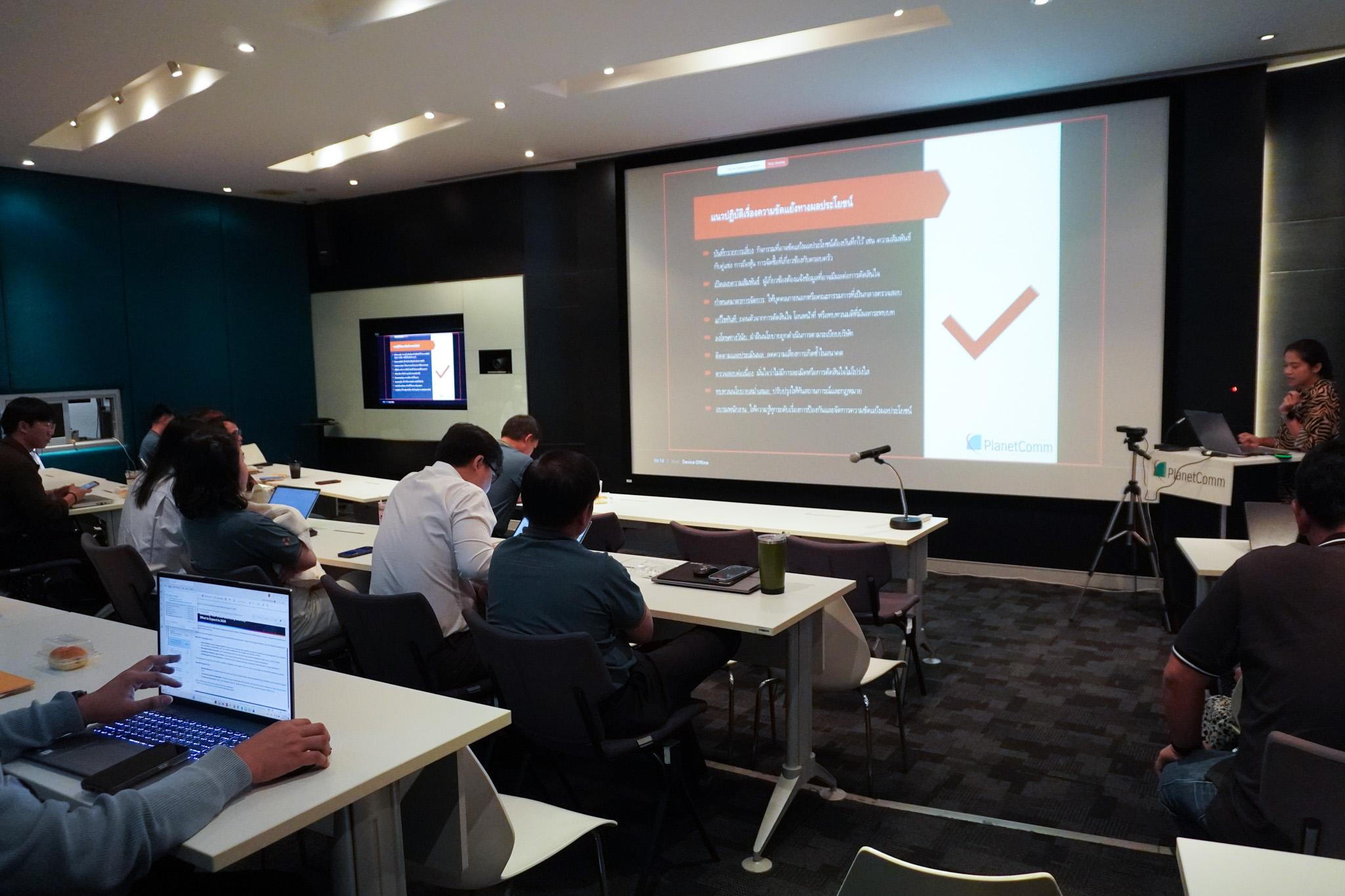
The Company has continuously promoted knowledge and awareness among directors, executives, and employees. In this regard, the Company organized training on the Code of Conduct, Anti-Corruption Policy, and Personal Data Protection (PDPA) during a Company meeting on October 10, 2025, with a 100% participation rate. The training covered key topics, including conflict of interest prevention, anti-corruption measures, whistleblowing and whistleblower protection, prevention of insider trading, anti-money laundering, policies on gifts and hospitality, compliance with laws and regulations, proper use and safeguarding of information and assets, prevention of unfair competition, information and cybersecurity, environmental management, human rights, and occupational health and safety. This initiative aims to strengthen the Company’s culture of ethics and transparency.

In addition, the Company has published its policies and guidelines on the use of inside information on its website to ensure that all relevant parties have equal and transparent access to such information. The Company’s Code of Conduct is also reviewed annually by the Board of Directors to ensure alignment with good corporate governance principles and applicable laws.

In 2025, the Company did not identify any cases of inappropriate use of inside information or violations of related regulations. This reflects the effectiveness of the Company’s governance system and its continued commitment to fostering a corporate culture of ethics and transparency.
Code of Conduct Link

https://www.planetcomm.com/wp-content/uploads/2026/03/%E0%B8%88%E0%B8%A3%E0%B8%A3%E0%B8%A2%E0%B8%B2%E0%B8%9A%E0%B8%A3%E0%B8%A3%E0%B8%93%E0%B8%98%E0%B8%B8%E0%B8%A3%E0%B8%81%E0%B8%B4%E0%B8%88-2568.pdf

Page Number in Report

3

Code of Conduct Practices

GuidelineOther — Please SpecifyDetailDocument LinkPage Number in Report
Prevention of Misuse of Inside Information

The Company has established measures to prevent conflicts of interest that may arise from related party transactions between the Company and persons who may have conflicts. Stakeholders who have an interest in any matter are prohibited from participating in the approval process of such transactions.

The Board of Directors is responsible for ensuring that the Company complies with the Securities and Exchange Act, including relevant rules, regulations, notifications, orders, or directives issued by the Capital Market Supervisory Board (CMSB) and the Stock Exchange of Thailand (SET). This includes compliance with the disclosure requirements for related party transactions and the acquisition or disposition of material assets, as well as strict adherence to accounting standards set by professional accounting bodies.


A conflict of interest refers to a situation where a person is required to perform duties to achieve outcomes or benefits in line with the Company’s objectives, but instead acts to benefit themselves or related persons. This may result in the Company not receiving full benefits or even suffering damage. Such situations are often referred to as “conflicts of interest,” as they typically involve parents, siblings, relatives, close friends, or business entities in which the individual has relationships, interests, or shared benefits.

Guidelines for Directors and Employees

  1. Avoid entering into related-party transactions that may give rise to conflicts of interest with the Company.

  2. In cases where directors or employees engage in transactions with the Company, such transactions shall be conducted as if dealing with external parties, and such directors or employees must not be involved in the approval process.

  3. Do not engage in businesses that compete with or have similar characteristics to the Company’s business.

  4. Do not use inside information for personal benefit in trading the Company’s securities, nor disclose such information to others for trading purposes. Directors and employees must also refrain from trading the Company’s securities during the one-month period prior to the disclosure of financial statements or material information that may affect the Company’s share price.

  5. During employment and after termination, employees must not disclose any confidential information of the Company for the benefit of any party, including electronic data, financial information, operational procedures, business information, or future plans.

Measures and Approval Procedures for Related Party Transactions

In cases where directors, executives, or employees engage in related-party transactions with the Company, the Company has established measures to govern such transactions. The Audit Committee is responsible for reviewing and providing opinions on the necessity, reasonableness, and pricing appropriateness of such transactions, ensuring they are conducted under normal business conditions and at market prices comparable to those with external parties.

If the Audit Committee lacks sufficient expertise to assess such transactions, the Company will appoint independent experts—such as auditors, asset appraisers, or legal advisors—who have no relationship with the Company or any conflicted parties, to provide opinions for consideration. These opinions will support the Audit Committee’s review before submission to the Board of Directors or the shareholders’ meeting, as applicable.

Furthermore, the Company ensures that executives or interested persons are not involved in the approval of transactions in which they have a direct or indirect interest. The Company complies with the regulations of the Stock Exchange of Thailand, ensuring that such transactions are conducted on an arm’s length basis.

The Company also discloses related-party transactions in its Annual Report and Form 56-1 One Report, in accordance with accounting standards prescribed by the Federation of Accounting Professions and certified auditors in Thailand. Details of such transactions are disclosed in the notes to the financial statements, which are audited or reviewed by the Company’s external auditors.

https://www.planetcomm.com/wp-content/uploads/2026/03/%E0%B8%88%E0%B8%A3%E0%B8%A3%E0%B8%A2%E0%B8%B2%E0%B8%9A%E0%B8%A3%E0%B8%A3%E0%B8%93%E0%B8%98%E0%B8%B8%E0%B8%A3%E0%B8%81%E0%B8%B4%E0%B8%88-2568.pdf5
Anti-corruption

The Company has expressed its commitment to participating in the Thai Private Sector Collective Action Against Corruption (CAC) and began anti-corruption initiatives in 2014. Since then, management has taken steps to improve the Company’s operational procedures and internal control systems to prevent corruption.

In 2016, the Company adopted a formal Anti-Bribery and Anti-Corruption Policy, as well as a Whistleblowing Policy for reporting misconduct and fraudulent activities.

In 2017, the Company reaffirmed its commitment to the CAC initiative to further strengthen stakeholder confidence in its corporate governance practices. At the same time, the Company established clear anti-corruption and prevention policies aimed at promoting transparency and upholding its strong stance against all forms of corruption, whether direct or indirect.

The Company was officially certified as a member of the Thai Private Sector Collective Action Against Corruption (CAC) by the CAC Committee on May 17, 2018.

Anti-Corruption Policy

Planet Communications Asia Public Company Limited operates as a Digital Technology Services Provider, offering comprehensive solutions in system design, installation, and distribution. The Company has clearly stated its vision and commitment to building a sustainable and innovative future—economically, socially, and environmentally—by upholding strong corporate governance, ethical business conduct, transparency, and accountability, particularly in processes susceptible to fraud or corruption.

In alignment with this commitment, the Company has established the following Anti-Bribery and Anti-Corruption Policy:

  1. Directors, executives, employees, stakeholders, and subsidiaries are strictly prohibited from engaging in or accepting all forms of corruption, whether directly or indirectly. This applies to all business operations, in all countries, and all relevant entities. Compliance with this policy must be regularly reviewed and updated to reflect changes in business operations, regulations, and applicable laws.

  2. Anti-corruption measures are an integral part of the Company’s operations and the responsibility of all directors, executives, employees, stakeholders, and subsidiaries. Everyone is encouraged to provide input to ensure that anti-corruption practices align with the established policies.

  3. The Company develops anti-corruption measures that comply with applicable laws and ethical standards, including risk assessments of activities that are potentially vulnerable to corruption, which are then used to create practical guidelines for all relevant parties.

  4. The Company does not engage in or support bribery in any form. This includes all activities under the Company’s responsibility, such as charitable donations, political contributions, business gifts, and sponsorships. All such actions must be conducted with transparency and must not intend to influence government officials or private entities to act improperly.

  5. The Company maintains effective and consistent internal controls to prevent inappropriate conduct, particularly in the areas of sales, marketing, and procurement.

  6. The Company provides anti-corruption training to its directors, executives, and employees to promote integrity, honesty, and accountability in their duties and to reinforce the Company’s commitment to ethical practices.

  7. The Company ensures transparency and accuracy in its financial reporting.

  8. The Company promotes open and accessible communication channels for whistleblowing. Employees and stakeholders are encouraged to report suspected misconduct with the assurance that whistleblowers will be protected from punishment, unfair transfers, or retaliation. The Company also appoints responsible personnel to monitor and investigate all submitted reports.

https://www.planetcomm.com/wp-content/uploads/2026/03/Anti-Corruption-Manual-20260226-2026.pdf7
Whistleblowing and Protection of Whistleblowers

Objective

In alignment with the Company’s Anti-Corruption Policy, the Board of Directors recognizes the importance of establishing a Whistleblowing Policy as a mechanism for receiving complaints regarding violations of laws, regulations, and the Company’s code of conduct. This includes reports from employees, stakeholders, or external parties that may affect the Company’s reputation or assets.

The purpose of this policy is to assure employees that their complaints will be taken seriously, and their identity will be strictly protected. Whistleblowers will not face retaliation or unfair treatment, such as threats or disciplinary actions. The Company is also committed to ensuring that employees who reject corruption will not face demotion, punishment, or any negative consequences.

Confidentiality Measures

To protect the rights of whistleblowers acting in good faith, the Company will keep their identity—such as name, address, or any identifying details—strictly confidential. Access to such information will be limited to those directly responsible for handling the investigation.

Procedures for Handling Complaints

  1. Reporting Channels

    Shareholders, employees, and all stakeholders may report any wrongdoing, including violations of laws, Company policies, or the business code of conduct, to the Chairman of the Board or the Chairman of the Audit Committee via postal mail or through the Company’s website.

    Mailing Address:

    Chairman of the Board / Chairman of the Audit Committee

    Planet Communications Asia Public Company Limited

    157 Soi Ram Intra 34, Tharang Subdistrict, Bang Khen District, Bangkok 10230

    Employees may also report concerns to:

    1. A trusted supervisor at any level

    2. The Chairman of the Audit Committee

    3. The Chairman of the Board

    4. The Company Secretary

  2. Handling of Complaints

    1. The designated recipient will collect and verify facts or assign a qualified person to do so.

    2. Verified reports and supporting evidence will be submitted to the Chairman of the Board or the Audit Committee, as appropriate.

    3. If found credible, the matter will be forwarded to the Audit Committee for further action.

    4. Whistleblowers acting in good faith will not be penalized even if the allegations are later found unsubstantiated.

    5. However, if a report is made maliciously or with false information, disciplinary action—including possible termination or legal prosecution—may be taken.

    6. The Company will handle each case with independence and impartiality. A summary of the outcome will be provided to the whistleblower if contact information is available, subject to data protection and confidentiality limitations.

  3. Whistleblower Protection Measures

    1. Whistleblowers and witnesses will be protected; their identities will remain known only to the complaint handler and the Chairman or Audit Committee.

    2. No threats, retaliation, or intimidation will be tolerated against whistleblowers or those cooperating in good faith.

    3. Any intimidation must be reported to a trusted supervisor immediately for appropriate protective measures.

    4. No disciplinary action, dismissal, or threats shall be taken against whistleblowers. Violators of this policy will be subject to disciplinary action.

    5. The Company guarantees fairness and protection to employees who reject corruption—even if it results in missed business opportunities.

This Whistleblowing Policy shall be reviewed and revised as necessary, and at least once annually, to ensure relevance and effectiveness

https://www.planetcomm.com/wp-content/uploads/2025/03/2.-%E0%B8%99%E0%B9%82%E0%B8%A2%E0%B8%9A%E0%B8%B2%E0%B8%A2%E0%B8%81%E0%B8%B2%E0%B8%A3%E0%B9%81%E0%B8%88%E0%B9%89%E0%B8%87%E0%B9%80%E0%B8%9A%E0%B8%B2%E0%B8%B0%E0%B9%81%E0%B8%AA.pdf2-4
Preventing the Misuse of Inside Information

Policy on the Use of Inside Information

Planet Communications Asia Public Company Limited is a listed company on the Market for Alternative Investment (mai). The Company places great importance on ensuring fairness and equal treatment for all shareholders. Inside information or material information that may affect the price of the Company’s securities and has not yet been disclosed to the public is considered confidential information used in the Company’s business operations. Such information may affect the value of the Company’s shares traded on the stock exchange.

Therefore, directors, executives, and employees at all levels are required to keep inside information strictly confidential and must not disclose such information obtained through the performance of their duties to others, nor use such information for personal gain or for trading the Company’s securities, or in any manner that may cause damage to the Company, whether directly or indirectly. The Company has established the following guidelines:

  1. Directors, executives, employees, and staff of the Company are prohibited from disclosing or using the Company’s confidential information and/or inside information for their own benefit or for the benefit of any other person, whether directly or indirectly, regardless of whether any compensation or benefit is received.

  2. Directors, executives, employees, and staff of the Company, including their spouses and minor children, are prohibited from using inside information of the Company that may affect the price of the Company’s securities and that has not yet been disclosed to the public to buy, sell, offer to buy, offer to sell, or persuade others to buy or sell the Company’s securities, whether directly or indirectly, before such information has been publicly disclosed. This prohibition applies regardless of whether the action is undertaken for personal benefit or for the benefit of others, or for inducing others to act for the benefit of the person concerned. Any violation will be subject to the Company’s disciplinary measures.

  3. The Company has informed its executives of their duty to report their holdings of the Company’s securities, including those held by their spouses and minor children, as well as any changes in such holdings, to the Office of the Securities and Exchange Commission in accordance with Section 59 and the penalty provisions of the Securities and Exchange Act B.E. 2535 (1992).

  4. The Company prohibits directors, executives, employees, and staff of the Company, including their spouses and minor children, from trading the Company’s securities during the period of one month prior to the public disclosure of the Company’s financial statements.

https://www.planetcomm.com/wp-content/uploads/2026/03/%E0%B8%88%E0%B8%A3%E0%B8%A3%E0%B8%A2%E0%B8%B2%E0%B8%9A%E0%B8%A3%E0%B8%A3%E0%B8%93%E0%B8%98%E0%B8%B8%E0%B8%A3%E0%B8%81%E0%B8%B4%E0%B8%88-2568.pdfจรรยาบัน 6
Giving or receiving gifts, entertainment, or business entertainment

Gifts, Entertainment, Hospitality, and Other Expenses Policy

The Company recognizes that building strong relationships with business partners contributes to its continued success. The giving or receiving of gifts, hospitality, or other forms of business-related expenses may be permitted, provided that all of the following conditions are met:

  1. Not intended to influence, induce, or reward any person to gain improper advantage, whether explicitly or implicitly, in exchange for assistance or benefits

  2. In compliance with applicable laws and regulations

  3. Given in the name of the Company, not in the name of any individual employee

  4. Not in the form of cash or cash equivalents (e.g., gift cards or vouchers)

  5. Appropriate to the occasion, such as customary gifts during traditional festivals

  6. Appropriate in type and value, and given in a proper context; for example, during a bidding process, employees must not accept gifts or hospitality from participating bidders

  7. Not considered bribery of government officials and/or inter-agency corruption

  8. Business entertainment and related expenses are acceptable if they are reasonable and not excessive, and are in line with contractual obligations

Procedures for Giving or Receiving Gifts

  1. The proposing department must assess whether the giving or receiving of gifts complies with Company policy. Gifts or souvenirs should not exceed a value of THB 5,000

  2. If an employee receives a gift, it must be reported to management and handed over to the relevant administrative unit for recording in the “Gift Receipt Log”, with approval from the authorized person or supervisor, for appropriate use for the Company’s benefit

  3. In the case of giving gifts, the Marketing Communications Department or relevant unit must compile the list, complete the request form, and submit it for approval by the Chief Executive Officer

  4. The Accounting Department verifies supporting documents for payment vouchers

  5. The Finance Department issues payments with authorized signatories and ensures proper receipt documentation

  6. The Accounting Department maintains all documentation for record-keeping and audit purposes

Guidelines

  1. Prior to giving or receiving gifts, ensure compliance with applicable laws and Company regulations. Gifts should not exceed THB 5,000 or be excessive for the occasion

  2. Do not give or receive gifts in the form of cash, checks, bonds, shares, gold, jewelry, real estate, or similar items

  3. Do not give or receive gifts that may improperly influence decision-making in the course of duty

  4. Maintain proper records of all related expenses for audit and verification purposes

https://www.planetcomm.com/wp-content/uploads/2025/03/16.-Anti-Corruption-Manual-20250228.pdfanti 15
Compliance with laws, rules and regulations

The Company places importance on complying with all applicable laws, regulations, and rules. Directors, executives, and employees must strictly adhere to laws and perform their duties in accordance with the Company’s policies, orders, announcements, and regulations, as well as requirements of relevant authorities. All personnel must understand their responsibilities regarding legal compliance, regularly review compliance with applicable laws and regulations, and ensure consistent adherence in their operations

https://www.planetcomm.com/wp-content/uploads/2026/03/%E0%B8%88%E0%B8%A3%E0%B8%A3%E0%B8%A2%E0%B8%B2%E0%B8%9A%E0%B8%A3%E0%B8%A3%E0%B8%93%E0%B8%98%E0%B8%B8%E0%B8%A3%E0%B8%81%E0%B8%B4%E0%B8%88-2568.pdf 5
Use and maintenance of data and assets

The Company is committed to maintaining standards relating to operational systems and information technology systems, which are fundamental to establishing an effective control system. The Company undertakes various measures to ensure that financial information is accurate, complete, transparent, and verifiable. In addition, the Company maintains efficient systems for the storage, access, recording, protection, and backup of computer data, ensuring that such information can be recovered within an appropriate period of time.

The Company also prevents the misuse of information for personal benefit, including use by whistleblowers, related persons, and/or businesses competing with the Company, whether directly or indirectly, in a manner that lacks ethics and good conscience.

To achieve this commitment under the Company’s Code of Conduct and Corporate Governance Policy, the Company has established guidelines for the storage, access, recording, protection, and backup of financial data as follows:

  1. Financial documents and information stored both within and outside the Company must have proper systems for storage, access, recording, and protection to prevent unauthorized persons from accessing, modifying, altering, destroying, and/or improperly recording information, whether accidentally or intentionally. Such systems must also allow financial documents and information to be reviewed or verified at a later time.

  2. All activities relating to information technology systems and communications must comply with the Company’s policies and procedures on information access, usage control, and information security at all times.

  3. Risk assessments must be conducted and appropriate risk control systems must be established and regularly updated to remain consistent with changing environments.

  4. Executives and employees must safeguard and protect their user accounts (Username) and passwords. They must not share them with others, disclose or distribute them, or allow others to access them without authorization.

https://www.planetcomm.com/wp-content/uploads/2025/03/16.-Anti-Corruption-Manual-20250228.pdf20
Anti-competitive

The Company is committed to conducting its business in accordance with fair competition principles and maintaining appropriate standards of competitive practices. The Company adheres to the following guidelines:

  1. Not to seek confidential information of competitors through dishonest or inappropriate means.

  2. Not to damage the reputation of competitors by making defamatory or false allegations.

  3. Not to engage in any actions that infringe upon the intellectual property rights of competitors.

  4. Not to undertake any covert actions against competitors that may negatively affect them in order to gain unfair advantage for the Company.

https://www.planetcomm.com/wp-content/uploads/2026/03/%E0%B8%88%E0%B8%A3%E0%B8%A3%E0%B8%A2%E0%B8%B2%E0%B8%9A%E0%B8%A3%E0%B8%A3%E0%B8%93%E0%B8%98%E0%B8%B8%E0%B8%A3%E0%B8%81%E0%B8%B4%E0%B8%88-2568.pdf 9
Cyber security

The Company has established an Information Security Management System (ISMS) in accordance with the ISO/IEC 27001 standard to ensure the security of information and IT systems, and to support efficient business operations. The Company emphasizes that personnel at all levels must be aware of and strictly comply with this policy.

Key Principles

  • Protect information confidentiality (Confidentiality)

  • Maintain data accuracy and completeness (Integrity)

  • Ensure system availability (Availability)

  • Operate in compliance with applicable laws and relevant standards

  • Continuously review and improve the policy

Key Practices

  1. Policy Establishment and Support

    • Develop information security policies, with appropriate allocation of resources and budget

    • Promote awareness and understanding among personnel

  2. Information Control (CIA)

    • Implement confidentiality measures such as Non-Disclosure Agreements (NDA)

    • Define access rights based on roles and responsibilities

    • Establish data backup systems and prevent unauthorized access

  3. Legal Compliance

    • Comply with laws, regulations, and requirements related to IT and data security

  4. Governance Structure

    • Appoint an Information Security Committee or working team to drive policy implementation

  5. People Development

    • Provide onboarding training for new employees and conduct regular security awareness training

  6. Business Continuity

    • Establish and regularly test a Business Continuity Plan (BCP)

https://www.planetcomm.com/wp-content/uploads/2026/03/%E0%B8%9B%E0%B8%A3%E0%B8%B0%E0%B8%81%E0%B8%B2%E0%B8%A8%E0%B8%99%E0%B9%82%E0%B8%A2%E0%B8%9A%E0%B8%B2%E0%B8%A2%E0%B8%A3%E0%B8%B0%E0%B8%9A%E0%B8%9A%E0%B8%9A%E0%B8%A3%E0%B8%B4%E0%B8%AB%E0%B8%B2%E0%B8%A3%E0%B8%84%E0%B8%A7%E0%B8%B2%E0%B8%A1%E0%B8%A1%E0%B8%B1%E0%B9%88%E0%B8%99%E0%B8%84%E0%B8%87%E0%B8%9B%E0%B8%A5%E0%B8%AD%E0%B8%94%E0%B8%A0%E0%B8%B1%E0%B8%A2%E0%B8%AA%E0%B8%B2%E0%B8%A3%E0%B8%AA%E0%B8%99%E0%B9%80%E0%B8%97%E0%B8%A8-Feb-1-2023-Signed.pdf
Environmental management

The Company promotes and conducts its business with responsibility toward communities, society, and the environment, including safety, quality of life, natural resource conservation, and efficient energy use. The Company recognizes the importance of community well-being and allocates part of its profits to support and contribute to social development. It also considers the environmental impact of its operations by adopting appropriate technologies and developing innovations that promote efficient energy utilization.

The Company promotes environmentally friendly procurement practices (Green Procurement) by adopting electric vehicles (EVs) in its transportation and logistics operations to reduce greenhouse gas emissions and air pollution from fossil fuel consumption. This initiative enhances energy efficiency, reduces long-term fuel costs, and supports the Company’s environmental objectives. It also elevates supply chain operations in alignment with ESG principles and sustainable development practices. In addition, the Company encourages its business partners to adopt electric vehicles and green logistics practices, thereby creating a positive environmental impact and contributing to tangible carbon emission reduction across the supply chain.

https://www.planetcomm.com/wp-content/uploads/2026/03/%E0%B8%88%E0%B8%A3%E0%B8%A3%E0%B8%A2%E0%B8%B2%E0%B8%9A%E0%B8%A3%E0%B8%A3%E0%B8%93%E0%B8%98%E0%B8%B8%E0%B8%A3%E0%B8%81%E0%B8%B4%E0%B8%88-2568.pdf9
Human rights

The Company upholds human rights principles. Directors, executives, and employees must not commit or support any actions that violate the rights of others. Employees have the right to privacy and protection of personal data. The Company treats employees equally without discrimination based on race, religion, gender, age, or other factors, and promotes mutual respect and fairness. Recruitment and performance evaluations are conducted transparently, and the workplace environment must be free from harassment or unfair treatment

https://www.planetcomm.com/wp-content/uploads/2026/03/%E0%B8%88%E0%B8%A3%E0%B8%A3%E0%B8%A2%E0%B8%B2%E0%B8%9A%E0%B8%A3%E0%B8%A3%E0%B8%93%E0%B8%98%E0%B8%B8%E0%B8%A3%E0%B8%81%E0%B8%B4%E0%B8%88-2568.pdf10
Occupational health and safety

Employees are the Company’s most valuable resource and a key factor for success. The Company is committed to treating employees fairly and equally in terms of compensation, appointment, and continuous development. The Company complies with labor laws, ensures a safe working environment, respects employees’ privacy, and links compensation to performance. It also supports employee development, provides appropriate welfare benefits, encourages feedback and complaints, and prioritizes occupational health, safety, and accident prevention in accordance with legal requirements

https://www.planetcomm.com/wp-content/uploads/2026/03/%E0%B8%88%E0%B8%A3%E0%B8%A3%E0%B8%A2%E0%B8%B2%E0%B8%9A%E0%B8%A3%E0%B8%A3%E0%B8%93%E0%B8%98%E0%B8%B8%E0%B8%A3%E0%B8%81%E0%B8%B4%E0%B8%88-2568.pdf7
Other guidelines related to business code of conductManagement and Enforcement of the Business Code of Conduct
  1. All directors, executives, and employees are required to acknowledge, understand, and strictly comply with the Business Code of Conduct. If any violation or action contrary to the Code of Conduct is discovered, the Company will consider and take appropriate action. In cases where such actions violate the Company’s rules and work regulations, disciplinary measures will be imposed in accordance with the Company’s work regulations, depending on the severity of the offense.

  2. All directors, executives, and employees are required to sign an acknowledgment of this Business Code of Conduct upon commencement of employment and whenever there are revisions to the Code.

  3. Executives and supervisors must act as role models in complying with the Business Code of Conduct and are responsible for supervising and encouraging their subordinates to follow the established Code of Conduct.

  4. In case of questions or uncertainties, employees should consult their supervisors or the persons designated by the Company to be responsible for monitoring compliance with the Code of Conduct through the designated communication channels.

  5. Any exemption from compliance with this Business Code of Conduct for executives or directors must receive approval from the Board of Directors.

https://www.planetcomm.com/wp-content/uploads/2026/03/%E0%B8%88%E0%B8%A3%E0%B8%A3%E0%B8%A2%E0%B8%B2%E0%B8%9A%E0%B8%A3%E0%B8%A3%E0%B8%93%E0%B8%98%E0%B8%B8%E0%B8%A3%E0%B8%81%E0%B8%B4%E0%B8%88-2568.pdf10

Promoting Compliance with the Code of Conduct

Promotes Compliance by Directors, Executives and Employees

Yes

Description

The Company places great importance on conducting its business with transparency, integrity, and in accordance with good corporate governance principles. Accordingly, the Company has established processes to ensure that the Board of Directors, executives, and employees at all levels strictly adhere to the Company’s Code of Business Conduct as follows:

  1. Policy and Code of Business Conduct
    The Company has established and implemented a Code of Business Conduct to serve as guidelines for directors, executives, and employees. The code sets out principles relating to ethics, transparency, prevention of conflicts of interest, anti-corruption, and fair treatment of stakeholders.

  2. Communication and Awareness
    The Company continuously communicates the Code of Business Conduct to personnel at all levels through internal meetings, training programs, the Company’s information systems, and activities that promote ethical practices in the workplace.

  3. Training and Personnel Development
    The Company provides training on the Code of Business Conduct, good corporate governance, and anti-corruption practices in order to enhance knowledge, understanding, and ethical awareness among employees.

  4. Governance and Internal Control System
    The Company has established appropriate governance and internal control systems to prevent misconduct, including clear approval procedures, monitoring mechanisms, and transparent operational oversight.

  5. Whistleblowing Channels
    The Company provides channels through which directors, executives, employees, and stakeholders may report misconduct or violations of the Code of Business Conduct. The Company ensures confidentiality and protection for whistleblowers in accordance with the established policy.

  6. Monitoring, Investigation, and Disciplinary Measures
    The Company regularly monitors and reviews compliance with the Code of Business Conduct. Any violations will be subject to appropriate disciplinary actions and legal measures where applicable.

Through these processes, the Company aims to foster an organizational culture based on integrity, transparency, and accountability toward all stakeholders.

Anti-Corruption Networks & Projects

Joined or Declared Intent to Join Anti-Corruption Networks

Yes

Networks & Projects Joined

Network / ProjectCAC Certified
Thai Private Sector Collective Action Against Corruption: CACY
United Nations Global Compact (UNGC)
Participation of anti-Corruption networks and initiatives

Material Changes & Developments in CG

Reviewed the CG Policy or Board Charter in the Past Year

Yes

Material Changes or Developments in the Past Year

Yes

Policy Review — Description

In 2025, the Company conducted an annual review of its corporate governance policies and practices, including the charters of the Board of Directors and its subcommittees, to ensure alignment with good corporate governance principles and applicable regulations.

At the Board of Directors Meeting No. 9/2025, held on August 13, 2025, the Board approved revisions to the Charter of the Nomination, Remuneration and Corporate Governance Committee, particularly under Section 3: Scope of Duties and Responsibilities, Clause 3.1 (Nomination), as follows:

  • Revision of Clause (2):
    From: “Consider the qualifications of independent directors, whereby independence must at least comply with the criteria prescribed by the Securities and Exchange Commission (SEC).”

    To: “Consider the qualifications of directors and independent directors, whereby such qualifications must at least comply with the criteria prescribed by the Securities and Exchange Commission (SEC).” This revision aims to cover the consideration of qualifications for all types of directors.

  • Addition of Clause (3):
    “Consider the qualifications of the Chief Executive Officer, taking into account experience, knowledge, capability, integrity, and leadership, and propose to the Board of Directors for approval.” This addition aims to strengthen the process of nomination and appointment of senior executives to ensure appropriateness, transparency, and alignment with good governance principles.

These revisions are intended to enhance the effectiveness of corporate governance, as well as to strengthen transparency and build confidence among shareholders and all stakeholders.

Implements the CG Code for Listed Companies

Yes

CG Code — Description

The Company recognizes the importance of good corporate governance as a key mechanism in building confidence among shareholders, investors, and all stakeholders. The Company fully adopts and complies with the Corporate Governance Code (CG Code) for listed companies to ensure that its business operations are transparent, efficient, and sustainable.

The Company has applied the CG Code in a manner appropriate to its organizational context, covering the following key areas:

  • Clear Roles, Duties, and Responsibilities of the Board of Directors
    The Board of Directors is responsible for setting the Company’s vision, strategies, and key policies, as well as overseeing management to ensure efficient, transparent operations aligned with long-term objectives.

  • Appropriate and Diverse Board Structure
    The Company emphasizes having a Board with diverse knowledge, expertise, and experience, including an appropriate proportion of independent directors in accordance with relevant regulations.

  • Effective Risk Management and Internal Control Systems
    The Company has established comprehensive risk management and internal control systems, with regular monitoring and evaluation to address strategic, operational, financial, and legal risks.

  • Oversight of Management Performance
    The Board continuously monitors management performance and establishes Key Performance Indicators (KPIs) aligned with corporate strategy, with a focus on long-term value creation.

  • Transparent and Comprehensive Disclosure
    The Company ensures that material information is disclosed accurately, completely, timely, and fairly, enabling shareholders and stakeholders to access information equally.

  • Protection of Shareholder Rights and Fair Treatment of Stakeholders
    The Company prioritizes shareholder rights, particularly those of minority shareholders, and promotes participation in shareholders’ meetings. It also ensures fair treatment of all stakeholder groups.

  • Promotion of Ethics and Anti-Corruption
    The Company has established clear policies and guidelines on business ethics and anti-corruption, and promotes strict adherence by employees at all levels.

In addition, the Company continuously reviews and enhances its corporate governance policies to align with applicable laws, regulations, and international best practices, supporting sustainable and long-term organizational growth.

Other CG Performance & Outcomes

In 2025, the Company demonstrated its continued commitment to conducting business in accordance with good corporate governance principles and anti-corruption practices. The Company successfully renewed its certification as a member of the Thailand’s Private Sector Collective Action Against Corruption (CAC) 2nd time for an additional period of three years to Year 2028

The CAC certification and its continuous renewal reflect the Company’s establishment of concrete anti-corruption policies, measures, and practices, as well as their effective implementation across the entire organization, covering the Board of Directors, executives, and employees at all levels.

For listed companies, CAC certification serves as an important mechanism for enhancing corporate governance standards, with significance in several key aspects as follows:

  • Enhancing Credibility and Confidence
    Certification from CAC, a nationally recognized organization, helps build confidence among shareholders, investors, business partners, and stakeholders that the Company operates with transparency and strong governance.

  • Mitigating Legal and Reputational Risks
    Having clear anti-corruption systems and measures reduces the risk of legal violations and potential reputational damage.

  • Elevating Business Standards to the International Level
    Compliance with CAC guidelines aligns with international best practices in corporate governance and anti-corruption, enhancing the Company’s competitiveness, particularly in global markets.

  • Promoting a Culture of Transparency and Ethics
    Operating under the CAC framework fosters a sustainable organizational culture of integrity and social responsibility.

The Company will continue to enhance and elevate its corporate governance standards to support stable, transparent, and sustainable long-term growth.

Contents